Whale Eye, Lip Licks and Yawns: What Your Dog's Subtle Stress Signals Really Mean
- •Whale eye, lip licks, and yawns are early stress signals — not random behaviours — and missing them leads to bigger problems.
- •These signals appear in a sequence: the earlier you catch them, the easier it is to help your dog.
- •Context is everything — a single signal means little, but clusters of signals together mean your dog is struggling.
- •You can respond to these signals in the moment to immediately reduce your dog's stress.
- •Recognising subtle signals is the foundation of preventing reactive outbursts and building real trust.
Your dog has been telling you they’re stressed for years — you just haven’t had the decoder ring. Whale eye, lip licks, and yawns are three of the most commonly missed stress signals, and when you learn to spot them, you’ll understand your dog on a completely different level.
What Exactly Is Whale Eye and Why Should You Care?
That crescent of white tells you more than a growl ever could.
Whale eye is when your dog turns their head slightly away from something but keeps their gaze fixed on it — revealing the white part of the eye in a curved crescent shape. It looks a little like side-eye, and that’s essentially what it is.
You’ll often see it when a child leans in for a hug, when a stranger approaches too fast, or when your dog is guarding a toy and you reach toward them. The head turns away, but the eyes stay locked. That tension is a warning — your dog is uncomfortable and monitoring the threat closely.
If you see whale eye and the situation continues without relief, a growl or snap is likely next. This is exactly the kind of early signal covered in the hub article How to Read Your Dog’s Body Language and Calming Signals: The Complete Guide for Perth Dog Owners — catching it early changes everything.
Whale eye is almost always paired with a stiff body and a slightly lowered head. If you see all three at once, create space immediately — remove the trigger or move your dog away before the situation escalates.
Why Does Your Dog Keep Licking Their Lips When Nothing Is Happening?
It's not about food — it's a nervous system response you can act on right now.
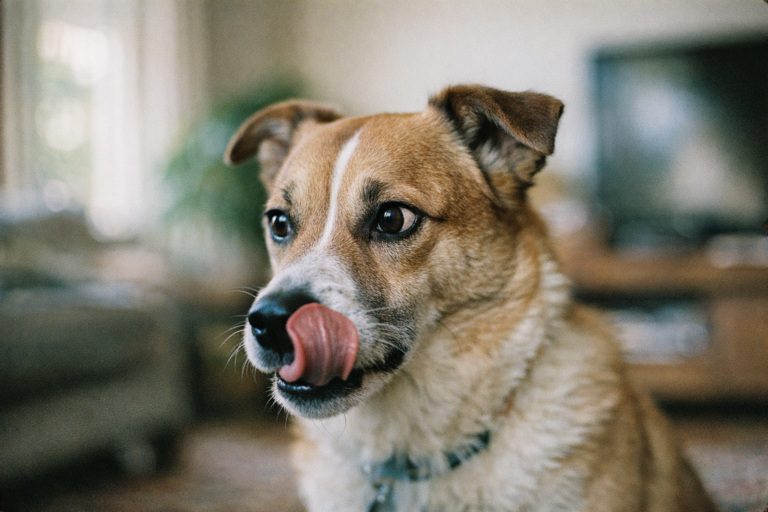
A quick flick of the tongue over the nose or lips — especially when there’s no food around — is one of the most frequent calming signals dogs use. It’s your dog’s way of saying “I’m not a threat, please don’t push this.”
You’ll notice it during greetings with unfamiliar dogs, in a vet waiting room, during training when the task feels too hard, or when someone in the family argues nearby. It’s displacement behaviour — the dog’s nervous system is trying to self-soothe and signal appeasement at the same time.
The important thing to understand is that a single lip lick in isolation might not mean much. But three lip licks in 30 seconds, combined with looking away and a low tail? That dog is telling you clearly: this is too much for me right now.
Is Your Dog's Yawn Really Just Tiredness — or Something More?
Most yawns you see in tense moments have nothing to do with sleep.
Dogs yawn when they’re tired, yes — but they also yawn as a deliberate calming signal directed at people or other dogs. A slow, exaggerated yawn in a tense situation is your dog actively trying to diffuse the pressure.
Try this: next time you’re leaning over your dog with direct eye contact, watch for a yawn. They’re not bored — they’re asking you to back off slightly and lower the intensity. Many owners accidentally punish this signal by pressing on regardless, which teaches the dog their communication doesn’t work.
When you see a stress yawn, the right response is to look away, soften your posture, and give your dog a moment. You’ll often see them visibly relax within seconds. That’s not coincidence — that’s communication working exactly as it should.
You can actually use yawning back at your dog as a calming signal yourself. It sounds odd, but many dogs visibly soften when their owner yawns slowly in a tense moment. This is explored further in How to Use Calming Signals in Your Own Body Language to Communicate Better With Your Dog.
What Other Subtle Signals Are Easy to Miss?
These four signals show up before the obvious ones — learn them and you're always ahead.
Beyond the big three, there’s a cluster of signals that tend to appear in the early stages of stress — before whale eye, before lip licks, sometimes before you even sense anything is wrong.
- •Blinking slowly or looking away: your dog is trying to reduce the intensity of an interaction.
- •Sniffing the ground suddenly: in a social or tense situation, this is avoidance — not genuine interest in a smell.
- •Shaking off (like shaking water away) when they're not wet: this is a physical reset after a stressful moment.
- •Turning the body sideways: presenting a curved, non-threatening profile to a person or dog they're unsure about.
- •Scratching out of context: a sudden scratch during training or greeting often signals conflict, not an itch.
These signals cluster together. One signal is a whisper. Three signals at once is a shout. When you see a dog sniffing the ground, then shaking off, then licking their lips during a park greeting, that dog is working overtime to manage their stress — and they need your help.
If you’re regularly in situations with other dogs — like off-leash parks — it’s worth reading Dog Body Language in the Park: How to Spot Trouble Before It Starts alongside this. Knowing your own dog’s signals is only half the picture.
How Do You Respond When You Spot These Signals in Real Time?
Recognising a signal is step one — responding correctly is where the trust gets built.
Spotting a stress signal is only useful if you do something with it. The goal isn’t to remove every challenge from your dog’s life — it’s to respond in a way that tells your dog you heard them.
- •Step 1: Pause what you're doing the moment you see a cluster of signals.
- •Step 2: Increase physical distance between your dog and the trigger — even 2-3 metres can be enough.
- •Step 3: Use your own calming body language: turn slightly sideways, look away, lower your energy.
- •Step 4: Give your dog a moment to self-regulate — sniffing, shaking off, or moving freely are all good signs.
- •Step 5: Once your dog looks calmer, re-engage at a lower intensity or from a greater distance.
For dogs who are already showing reactive behaviour — barking, lunging, or freezing — these subtle signals were almost certainly present earlier and missed. Early intervention is always easier than trying to manage a dog who has already crossed their threshold. The article Understanding Reactive Dog Body Language: Early Warning Signs Every Owner Should Know goes deeper on this specific pattern.
Never punish a growl, whale eye, or lip lick. These signals are your dog’s communication tools — suppressing them doesn’t reduce the stress, it just removes the warning. A dog that stops signalling before they snap is far more dangerous than one who communicates clearly.
Questions Dog Owners Ask About Stress Signals
Honest answers to the things people actually wonder about when learning to read their dog.
My dog yawns and licks their lips all the time — does that mean they're always stressed?
Not necessarily — context is everything. A yawn after a nap is just a yawn. What you’re looking for is these signals appearing during interactions, in tense environments, or in clusters with other signals. If you’re seeing them constantly across all situations, it’s worth booking a behaviour consultation to rule out underlying anxiety.
Can a dog show stress signals even if they're not aggressive?
Absolutely — in fact, most dogs showing these signals are actively trying to avoid conflict, not start it. Stress signals are a communication system, not a threat. A dog who is signalling well is actually doing the right thing; your job is to listen and respond.
How long does it take to get good at reading these signals?
Most owners start noticing whale eye and lip licks within a week of actively looking for them. The key is to watch your dog during everyday moments — greetings, training sessions, vet visits — rather than waiting for a dramatic situation. It becomes second nature faster than you’d expect.
Should I try to train my dog out of showing these signals?
No — and this is a common mistake. These signals are healthy communication, not bad behaviour. What you should focus on is reducing the situations that trigger chronic stress, and building your dog’s confidence so they need to use these signals less often. A trainer can help you map out a plan specific to your dog.
Ready to Finally Understand What Your Dog Is Telling You?
At Agile Dogs in Perth, we help you learn to read your dog’s signals and respond in ways that actually build trust. Call us on 0448 153 316 or send an enquiry — let’s start speaking your dog’s language together.
Part of our guide: How to Read Your Dog's Body Language and Calming Signals: The Complete Guide for Perth Dog Owners