How to Use Calming Signals in Your Own Body Language to Communicate Better With Your Dog
- •Calming signals are a two-way language — your dog reads your body just as much as you read theirs.
- •Simple posture shifts like turning sideways or crouching down can immediately reduce your dog's anxiety.
- •Most owners accidentally use threatening body language without realising it — and this guide shows you how to stop.
- •Practising calming signals consistently builds trust and speeds up every other area of your dog's training.
- •These techniques work especially well for nervous, reactive, or rescue dogs who are easily overwhelmed.
If your dog shuts down, bolts away, or goes stiff when you approach, the problem might not be your dog at all — it might be your body language. Most owners focus on reading their dog’s signals without ever stopping to ask what signals they’re sending back. Once you understand how to use calming signals deliberately, the whole relationship shifts.
What Are Calming Signals and Why Do They Work Both Ways?
The body language conversation your dog has been waiting for you to join.
Calming signals are the subtle gestures dogs use to de-escalate tension — yawning, looking away, turning the body sideways, sniffing the ground. Turid Rugaas, the Norwegian trainer who first documented them, observed around 30 distinct signals in domestic dogs. What most people miss is that dogs expect these signals back from the beings they live with.
When you loom over your dog, make direct eye contact, or rush straight toward them, you’re speaking in a language that reads as threatening — even if your intentions are loving. Your dog isn’t being stubborn or dramatic. They’re responding logically to what your body is saying. Our hub article, How to Read Your Dog’s Body Language and Calming Signals: The Complete Guide for Perth Dog Owners, covers how dogs use these signals among themselves — this post is about flipping the script and using them yourself.
The good news is that these signals are easy to learn and immediately effective. You don’t need equipment, treats, or a training session. You need to change how you hold your body — and your dog will notice within seconds.
Step 1: How Do You Use Sideways Body Orientation to Approach a Nervous Dog?
One small turn of your shoulders can be the difference between connection and shutdown.
Walking directly toward a dog — face-on, upright, making eye contact — is one of the most socially aggressive postures in canine language. Even with a confident dog, it’s a lot. With a nervous or reactive dog, it can trigger immediate avoidance or defensiveness.
Instead, turn your body 45 degrees sideways as you approach. Present your side, not your chest. This single adjustment signals that you’re not a threat and that you’re not demanding anything. Try it the next time your dog seems reluctant to come to you — approach at an angle, pause, and let them close the gap themselves.
If your dog tends to back away when you walk toward them, stop walking altogether and simply crouch sideways. In most cases, a curious or anxious dog will approach you within 20–30 seconds once the pressure is off.
Step 2: Why Should You Avoid Direct Eye Contact With a Stressed Dog?
Eye contact is powerful — but only when your dog has chosen to offer it first.
In canine social behaviour, sustained direct eye contact is a challenge or a threat. When you stare at your dog to get their attention, you may actually be making them more anxious, not less. This is especially relevant if your dog shows lip licks, whale eye, or yawning in your presence — signals covered in detail in our related article, Whale Eye, Lip Licks and Yawns: What Your Dog’s Subtle Stress Signals Really Mean.
To mirror a calming signal, soften your gaze and look slightly to the side rather than straight into your dog’s eyes. Blink slowly, or glance away entirely for a few seconds. You’ll often see your dog visibly relax — they may shake off, yawn, or approach you more willingly. Let eye contact be something they offer, not something you demand.
Step 3: How Does Crouching Down Change How Your Dog Perceives You?
Height reads as dominance — reducing it reads as safety.
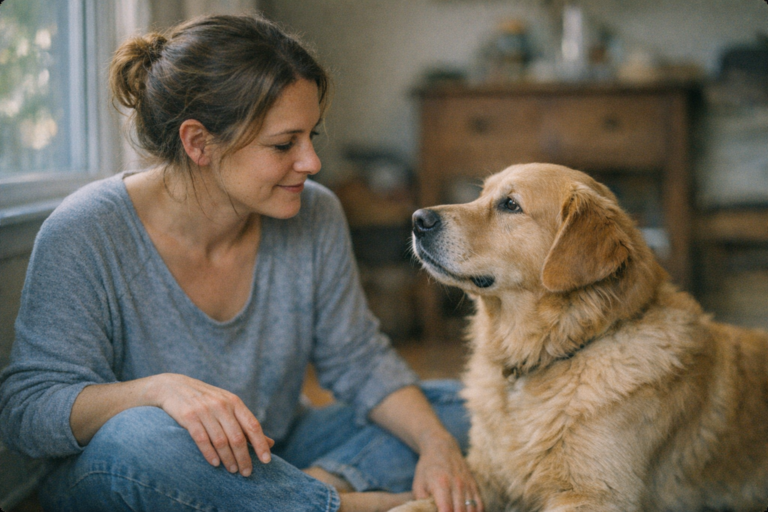
Your full standing height is genuinely imposing to a dog. When you crouch down — especially by turning to the side and lowering yourself rather than bending directly over them — you reduce the physical and emotional pressure dramatically. This is one of the fastest calming signals you can use with a dog who’s overwhelmed or unsure.
Avoid bending over a dog from above, which still feels looming. Instead, get low by crouching or sitting on the ground beside them. Let them sniff you at their own pace. This posture works especially well during greetings, after scolding (which you’ve since stopped using — right?), or when introducing your dog to a new environment.
If you work with a reactive dog, pairing this with slow movement and no eye contact is a powerful combination. You can read more about what’s happening in a reactive dog’s body before behaviour escalates in Understanding Reactive Dog Body Language: Early Warning Signs Every Owner Should Know.
Step 4: How Can Slowing Your Movements Send a Clearer Calming Message?
Fast movements signal urgency or threat — slow movements signal calm and safety.
Speed is a signal. Quick, jerky, or unpredictable movement raises arousal in dogs — it can read as either exciting or threatening depending on context. When you deliberately slow every movement down, you’re telling your dog there’s nothing to react to. This is particularly useful during leashing up, nail trims, vet visits, or any handling your dog finds uncomfortable.
Practise reaching toward your dog at half your normal speed, pausing mid-reach to let them process. No grabbing, no sudden lunges for the collar. You’ll find many dogs who are normally twitchy about handling start to tolerate — and eventually welcome — contact when the approach feels predictable and unhurried.
Slow movement is also one of the best tools for preventing conflict at the dog park. If you see tension building between dogs and need to step in, moving slowly and calmly — rather than rushing over — dramatically reduces the chance of escalating the situation. See Dog Body Language in the Park: How to Spot Trouble Before It Starts for the full picture on intervening safely.
Step 5: How Do You Use Yawning and Lip Licking as Intentional Calming Signals?
Yes — you can actually yawn at your dog and have it mean something.
This one surprises people, but it works. A slow, deliberate yawn directed at your dog during a tense moment — when they’re stressed at the vet, when training has hit a wall, or when they’re locked onto something that’s winding them up — can genuinely interrupt the stress cycle. Many dogs will yawn back within seconds.
Slow lip licks have a similar effect. These aren’t tricks — they’re signals your dog already understands because other dogs use them constantly. You’re simply speaking the language back. Keep the yawn slow and obvious, and pair it with a sideways glance rather than staring at your dog while you do it.
How Do You Build This Into Your Daily Routine Without Overthinking It?
Small, consistent changes in how you carry yourself make the biggest long-term difference.
You don’t need to run a dedicated training session to practise calming signals. Build them into the moments that already happen every day: coming home to greet your dog, calling them in from the yard, approaching them during rest, putting on their lead before a walk. These are the high-frequency interactions where your body language shapes your dog’s sense of safety over time.
Start with just one signal — the sideways approach is the easiest entry point. Do it for a week every time you walk toward your dog. Notice whether they seem more relaxed, whether recalls improve, whether they seek you out more. The feedback loop is fast when you’re consistent.
Over time, these adjustments stop being deliberate choices and become your natural way of moving around your dog. That’s when the real shift in the relationship happens — your dog learns that you’re someone who speaks their language, and trust becomes the foundation for everything else you work on together.
- •Approach at a 45-degree angle, never face-on
- •Soften your gaze — avoid prolonged direct eye contact
- •Crouch sideways rather than bending over your dog
- •Slow every movement down, especially during handling
- •Use deliberate yawns and slow lip licks to interrupt tension
- •Let your dog close the gap — don't force contact
Frequently Asked Questions About Using Calming Signals With Your Dog
Quick, honest answers to the questions Perth dog owners ask most.
Will Using Calming Signals Make My Dog Think I'm Weak or Less of a Leader?
Not at all — this is a really common concern, but it’s based on an outdated view of dog training. Calming signals are what confident, socially competent dogs use to communicate. Using them makes you more readable and trustworthy to your dog, which actually strengthens your relationship rather than undermining it.
How Quickly Will I See Results When I Start Using These Signals?
Most owners notice a difference within the first few days of consistently using even one signal — typically the sideways approach or crouching. Dogs are highly attuned to body language, so they pick up on changes in your movement and posture very quickly. Nervous or reactive dogs often show the most dramatic early response.
Do Calming Signals Work on All Dogs, Including Reactive or Fearful Ones?
Yes — in fact, reactive and fearful dogs benefit the most because they’re typically operating with an already elevated stress level. Calming signals reduce the pressure in your interactions and help them feel safer around you. That said, reactive dogs also need structured support — if you’re dealing with significant reactivity, professional guidance alongside these techniques will get you further, faster.
Can I Use Calming Signals to Help My Dog Around Strangers or Other Dogs?
Absolutely — and this is one of the most practical applications. Coaching visitors to approach your dog sideways and avoid eye contact can transform a greeting from stressful to smooth. At the dog park, using slow movement and indirect body orientation when approaching a tense situation gives other dogs a clear signal that you’re not a threat, which helps de-escalate before things get out of hand.
Ready to Build a Calmer, More Connected Relationship With Your Dog?
At Agile Dogs in Perth, we help you and your dog understand each other better — through practical, evidence-based training that starts with communication. Call us on 0448 153 316 or send an enquiry and let’s talk about where to start.
Part of our guide: How to Read Your Dog's Body Language and Calming Signals: The Complete Guide for Perth Dog Owners