
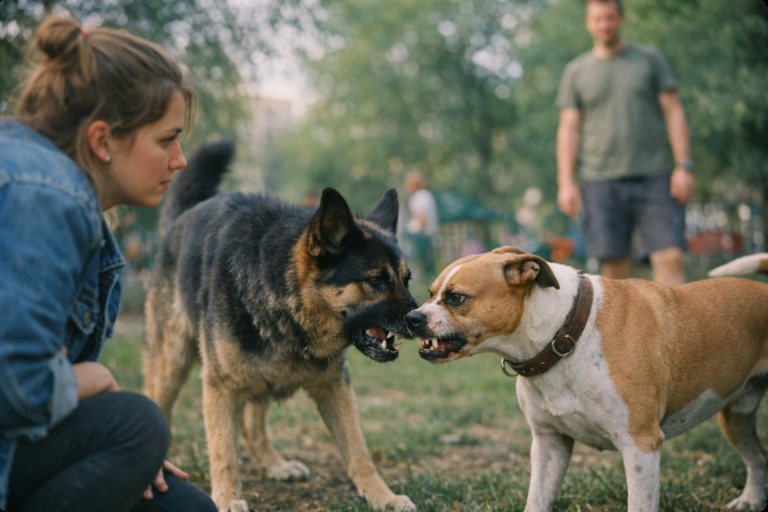
Dog Body Language in the Park: How to Spot Trouble Before It Starts
- •A stiff body and a hard stare are early warning signs that most owners miss — until it's too late.
- •The park is a high-stimulation environment where stress signals escalate faster than anywhere else.
- •You can prevent most confrontations by reading the situation 10–15 seconds before your dog reacts.
- •Knowing which signals to watch in other dogs is just as important as knowing your own dog's triggers.
- •Simple positioning habits — where you stand, how you move — can de-escalate tension before it builds.
The dog park should be fun. But if you’ve ever watched a relaxed afternoon turn into a snarling standoff in under five seconds, you know how fast things can go wrong. Most incidents don’t come out of nowhere — they follow a clear sequence of body language signals that the dogs were broadcasting the whole time. The problem is, most of us aren’t trained to see them yet.
Why Is the Park So Much Harder to Read Than Your Backyard?
High arousal and unfamiliar dogs make every signal harder to interpret accurately.
At home, your dog is relaxed, you know their baseline, and there are no surprises. At the park, arousal levels spike quickly — new smells, strange dogs, excited kids, and squeaky toys all compete for attention at once. A dog who gives clear, easy-to-read signals in the backyard may compress or skip signals entirely when they’re over-threshold.
This compression is exactly why parks catch owners off-guard. Your dog might go from slightly tense to reactive in two seconds instead of ten, because the environment has already pushed them close to their limit before the interaction even begins. Understanding this helps you start watching earlier — before your dog is even near another dog.
If you want to build a solid foundation before diving into park-specific scenarios, the How to Read Your Dog’s Body Language and Calming Signals: The Complete Guide for Perth Dog Owners covers every core signal in detail and is the best place to start.
What Does a Relaxed Dog Actually Look Like at the Park?
You need a clear baseline before you can spot when something shifts.
A genuinely relaxed dog moves with a loose, wiggly body. Their mouth is soft and slightly open, their tail swings in a low, easy arc, and their weight is balanced evenly over all four paws. They check in with you occasionally, sniff the ground freely, and break off interactions without stiffening.
This is your reference point. The moment you notice your dog’s body shift from fluid to tight and deliberate — weight pushed forward, tail raised and stiff, mouth closed — something has changed in how they’re processing the environment. That shift is your cue to act, not wait.
A tail held high and wagging stiffly is not a happy signal — it’s a high-arousal signal. Fast, loose wagging from a low tail position is relaxed. Slow, rigid wagging from a high tail position means your dog is tense and assessing. These look similar from a distance, so get close enough to read the whole body, not just the tail.
Which Early Warning Signs Should You Watch for in Other Dogs?
The dog approaching your dog is telling you exactly what's coming — if you know how to look.
When another dog approaches yours, scan their whole body in one quick sweep. A direct, stiff-legged approach with a high tail, closed mouth, and hard, unblinking eye contact is a high-risk greeting posture. Compare that to a dog who curves their body slightly, sniffs the ground on the way in, and approaches from the side — that’s confident and polite.
Whale eye — where you can see the whites of a dog’s eyes — is one of the clearest signs that a dog is uncomfortable and about to react. Combined with a lip lick or a yawn in a high-energy context, it tells you the dog is trying to de-escalate but is close to their limit. Our article on Whale Eye, Lip Licks and Yawns: What Your Dog’s Subtle Stress Signals Really Mean breaks these micro-signals down in much more detail.
Also watch for piloerection — the fur standing up along the spine. It can appear just between the shoulders, just above the tail, or along the full back. Any raised hackles mean the dog’s nervous system is firing. It’s not always aggression, but it always means heightened arousal, and that’s enough reason to create distance immediately.
How Do You Read the Interaction Once the Dogs Are Together?
Healthy play and mounting tension look totally different — once you know what to watch.
Healthy play involves role reversal and pauses. One dog chases, then the other chases back. One dog pins, then they swap. There are natural breaks where both dogs shake off, sniff the ground, or trot away briefly before re-engaging. This back-and-forth is the hallmark of balanced play.
Tension looks different. One dog is always on top, always chasing, always pinning — and the other dog isn’t getting a turn. Watch the dog on the receiving end: are they showing whale eye, tucking their tail, trying to move away, or freezing? If they are, the interaction has stopped being play and started being pressure. That’s your moment to step in calmly and interrupt.
- •Play bow (elbows down, bottom up) = genuine invitation to play
- •Bouncy, exaggerated movements = playful arousal, not threat
- •One dog consistently fleeing without re-engaging = not play, it's stress
- •Freezing mid-interaction = a very serious warning sign, act immediately
- •Repeated mounting despite the other dog moving away = the interaction needs to end
Call your dog away for a 30-second break every few minutes during play, even when things look fine. This keeps arousal levels from creeping up gradually, which is how many park incidents actually start — not with an obvious trigger, but with two dogs who’ve both been getting slowly more wound up for ten minutes.
What Should You Do With Your Own Body When Tension Is Building?
Your posture and movement send signals to every dog in that park — use them deliberately.
The instinct when you see trouble brewing is to rush in, call loudly, and pull your dog away. That instinct will almost always make things worse. Fast movement and a tense posture increase arousal in both dogs and can tip a tense moment into an actual incident. Instead, move slowly and smoothly, keep your body side-on rather than squared up, and use a calm, low voice.
Use your body as a calm physical barrier by walking slowly between the two dogs without rushing or leaning forward. Don’t grab collars from above — that’s a high-pressure action that can trigger a bite reflex in a stressed dog. Walk through, break the eye contact between them, and call your dog to follow you as you move away.
There’s a whole article dedicated to this — How to Use Calming Signals in Your Own Body Language to Communicate Better With Your Dog — and the techniques there translate directly to park situations. Your body is a tool; learning to use it well changes everything about how your dog responds to you under pressure.
How Do You Handle a Dog You Don't Know Approaching on Leash?
On-leash greetings carry far more risk than most owners realise — here's how to manage them safely.
On-leash greetings are genuinely risky, and it’s fine — actually smart — to opt out entirely. A leash restricts your dog’s ability to use their normal communication and escape options. Many dogs who are fine off-leash become reactive on-leash purely because they feel trapped. If another dog is approaching on-leash and you’re unsure, step off the path, put your dog in a sit beside you, and let them pass.
If a greeting does happen, keep the lead loose rather than tight. A tight lead communicates tension directly down the line to your dog. Give enough slack that both dogs can make small movements and sniff naturally, but stay alert and keep it brief — five seconds is plenty. If either dog stiffens, redirect and move on without making a drama of it.
For dogs who already show tension around other dogs on-leash, the article Understanding Reactive Dog Body Language: Early Warning Signs Every Owner Should Know will give you a much more detailed picture of the escalation sequence — and how to interrupt it early.
Questions Perth Dog Owners Ask About Park Body Language
Real answers to the questions that come up most on the training field.
My dog's tail is always wagging at the park — does that mean they're always happy?
Not necessarily. Tail position matters as much as movement. A low, loose wag signals relaxed happiness, while a high, stiff wag signals high arousal or alertness — which can tip into tension quickly. Always read the tail in context with the rest of the body: mouth, ears, weight distribution, and eye softness all tell part of the story.
How do I know if my dog is actually enjoying the dog park or just tolerating it?
A dog who’s enjoying the park actively re-engages after breaks, moves freely, and checks in with you with a relaxed face. A dog who’s merely tolerating it tends to hover near the exit, seek your legs repeatedly, show frequent lip licks or yawns, or go quiet and still. If your dog consistently shows those signs, the park may be doing more harm than good — and a controlled playdate with one known dog might suit them much better.
Another dog ran up and bowled my dog over — should I intervene straight away?
Watch your dog’s response first — some dogs bounce straight back and re-engage playfully, which means they’re fine. If your dog freezes, tucks, whale-eyes, or immediately tries to leave, step in calmly and create distance. Don’t wait for a growl or snap to confirm your dog is unhappy — those are last-resort signals, and your dog will have been communicating discomfort long before that point.
Is it rude to turn down a greeting from another dog at the park?
Not at all — it’s responsible and genuinely good dog ownership. You know your dog’s threshold better than anyone else there. A polite “sorry, he’s in training” or simply stepping away is completely acceptable. Forcing greetings when your dog is already anxious or over-aroused is far more likely to create a negative experience that makes future greetings harder, not easier.
Want to Feel Confident at the Park Instead of Anxious?
At Agile Dogs in Perth, we help you understand exactly what your dog is telling you — so you can step in early, keep everyone safe, and actually enjoy your time outside together. Give us a call on 0448 153 316 or tap below to get in touch.
Part of our guide: How to Read Your Dog's Body Language and Calming Signals: The Complete Guide for Perth Dog Owners